Search behavior is changing rapidly. Buyers, sellers, and property investors are no longer relying only on traditional Google search results to find information. Many now turn to AI-powered platforms, voice assistants, and answer engines to get quick recommendations and detailed answers. This shift is changing how real estate businesses need to approach online visibility.
For real estate professionals, understanding AI Search Optimization for Real Estate is becoming increasingly important. Having a website that ranks on Google is valuable, but businesses also need content that search engines and AI platforms can understand, trust, and reference when answering relevant questions.
Two strategies playing an important role in this change are Answer Engine Optimization (AEO) and Generative Engine Optimization (GEO). Although they share some similarities, each serves a different purpose. Understanding how they work together can help real estate agents attract potential clients, establish credibility, and remain visible as search technology evolves.
What Is Answer Engine Optimization (AEO)?
Answer Engine Optimization, commonly known as AEO, focuses on making website content suitable for direct answers in search results.
Instead of simply displaying a list of websites, search engines increasingly provide answers to specific questions through featured snippets, People Also Ask sections, and voice search responses.
For example, someone searching for “How much commission does a real estate agent charge?” wants a straightforward explanation rather than having to visit several websites to find basic information.
AEO helps businesses structure their content so search engines can identify and understand these answers.
Some effective AEO practices include:
- Creating content around frequently asked questions.
- Using question-based headings that match actual searches.
- Providing short, informative answers beneath each heading.
- Organizing information with bullet points and numbered lists.
- Adding relevant structured data to help search engines interpret website content.
For real estate websites, these techniques can make service pages, educational articles, and FAQs more useful to both visitors and search engines.
What Is Generative Engine Optimization (GEO)?
Generative Engine Optimization focuses on improving the chances of website content being understood, referenced, and cited by AI-powered platforms.
Tools such as ChatGPT, Google AI Overviews, and Microsoft Copilot can generate answers by combining information from different sources. Rather than simply showing website links, they may summarize information and provide references to relevant sources.
GEO aims to make your website a credible source of information that these systems can potentially use when generating responses.
For example, someone might ask about an AI platform:
“Which marketing strategies help real estate agents generate more qualified leads?”
A useful response could include information about local SEO, property-focused content, social media marketing, email campaigns, and paid advertising.
Real estate businesses that consistently publish informative, accurate, and experience-driven content have a better opportunity to establish authority around these subjects.
Important GEO practices include:
- Publishing comprehensive and informative articles.
- Including original insights and practical industry examples.
- Demonstrating professional experience and expertise.
- Supporting important claims with reliable references.
- Keeping website information accurate and updated.
- Maintaining consistent business information across online platforms.
The goal is not simply to publish more content. It is to create information that genuinely helps people make better decisions.
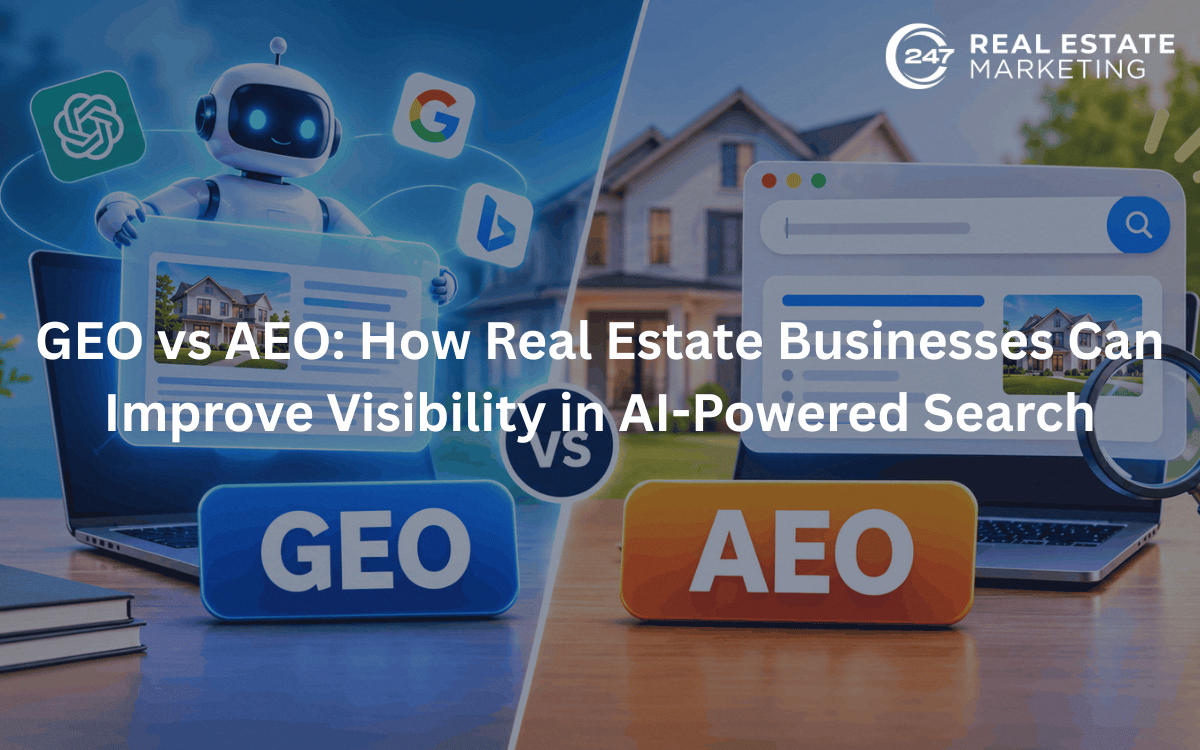
GEO vs AEO: What Is the Difference?
Although both approaches improve visibility beyond traditional search rankings, their primary objectives are different.
AEO focuses on making information easy to extract as a direct answer, while GEO focuses on making content valuable enough to be referenced in AI-generated responses.
Here are the main differences:
AEO focuses on:
- Answering specific search questions.
- Creating concise and informative explanations.
- Improving opportunities for featured snippets.
- Organizing content into question-and-answer formats.
- Targeting searches with clear user intent.
GEO focuses on:
- Building topical authority.
- Publishing detailed and trustworthy information.
- Demonstrating industry expertise.
- Including original insights and research.
- Improving visibility across generative AI platforms.
For example, an article answering, “How do real estate agents generate leads?” can use AEO by providing a direct explanation near the beginning.
The same article can support GEO by exploring different lead generation methods, explaining their advantages, providing practical examples, and referencing credible industry information.
Why Real Estate Businesses Need Both Strategies
Real estate decisions often involve considerable research. Buyers want to understand property prices, financing options, and neighborhood conditions. Sellers want to know how to prepare their homes, select an agent, and attract serious buyers.
These searches create opportunities for real estate websites to provide helpful information at different stages of the decision-making process.
Combining AEO and GEO can help businesses address both immediate questions and more complex research needs.
For example, a real estate website could publish:
- Short FAQs about buying and selling properties.
- Guides explaining the home-selling process.
- Articles about local property market trends.
- Information about real estate investment opportunities.
- Educational content about mortgages and property financing.
Short answers help address specific questions, while detailed guides demonstrate broader knowledge.
A balanced strategy also gives potential clients more opportunities to discover your business before they are ready to make an enquiry.
Practical Ways to Optimize Real Estate Content for AEO
You don’t need to completely redesign your content strategy to start implementing AEO. Small improvements to existing pages can make information easier to understand.
1. Use Questions as Content Headings
Think about the questions buyers and sellers commonly ask.
Instead of using a general heading such as “Benefits of Working with an Agent,” consider questions like:
- Why Should You Hire a Real Estate Agent?
- How Can an Agent Help You Sell Your Property?
- What Should First-Time Homebuyers Know?
These headings make the purpose of each section clear.
2. Provide Direct Answers
After every question-based heading, provide a straightforward answer before expanding on the topic.
For instance, explain what a real estate agent does in two or three sentences, then discuss their responsibilities, experience, and benefits in greater detail.
This structure makes content easier to scan and understand.
3. Add Helpful FAQ Sections
FAQs are particularly useful for answering specific questions that may not require an entire blog post.
Include questions about property valuations, buying procedures, agent commissions, marketing services, and local markets.
Make sure every answer is accurate and genuinely useful.
4. Use Relevant Structured Data
Structured data helps search engines understand specific information on your website.
Depending on the page, real estate businesses can consider relevant schema types such as Organization, Local Business, Article, and Breadcrumb List.
Always ensure that the markup accurately represents visible website content.
Practical Ways to Improve GEO Visibility
While AEO focuses on answer-ready information, GEO requires additional attention to credibility, depth, and originality.
1. Create Comprehensive Real Estate Guides
Avoid publishing articles that only explain basic concepts.
For example, instead of writing a short article about property marketing, create a detailed guide covering optimization, professional photography, local search visibility, social media promotion, and lead generation.
Comprehensive information provides greater value to readers and demonstrates subject knowledge.
2. Share Original Industry Insights
Generic information is already available across thousands of websites.
Give readers something more valuable by sharing practical observations, original research, case studies, and real marketing examples.
If you have completed successful campaigns, explain the challenges, strategies, and measurable outcomes where reliable data is available.
3. Establish Author Credibility
Readers want to know who is providing the information.
Include biographies, professional experience, relevant qualifications, and clear business information.
Demonstrating genuine expertise helps establish trust and gives visitors more confidence in their content.
4. Keep Existing Content Updated
Real estate markets, search trends, and marketing technologies change regularly.
Review older articles to identify outdated information, broken links, inaccurate examples, and opportunities to add useful insights.
An updated article should provide genuinely improved information rather than simply changing its publication date.
How a Digital Marketing Strategy Supports GEO and AEO
Implementing these strategies requires more than publishing occasional blog posts. Businesses need a consistent approach that connects website content, technical SEO, audience research, and conversion optimization.
This is where Real Estate Digital Marketing Services can support long-term online growth.
A well-planned strategy can bring together:
- Search engine optimization: Improve website structure, keyword targeting, technical performance, and organic visibility.
- Content marketing: Publish useful guides, service information, and educational articles.
- Website optimization: Make important information easy to find and understand.
- Local SEO: Strengthen local search visibility through accurate business information and relevant location-based content.
- Conversion optimization: Improve enquiry forms, contact buttons, and calls to action.
- Performance tracking: Monitor organic traffic, search impressions, leads, and visibility across relevant AI platforms.
These activities should work together rather than operate as separate marketing efforts.
Common Mistakes to Avoid When Implementing GEO and AEO
Many businesses make the mistake of treating these strategies as shortcuts to better rankings or instant AI visibility.
Avoid the following:
Keyword stuffing: Repeating search terms unnaturally makes content difficult to read. Focus on relevant topics and natural language.
Publishing shallow content: Articles that provide little information or simply repeat competitors offer limited value.
Ignoring technical SEO: Poor navigation, slow loading times, broken links, and indexing problems can affect website accessibility and performance.
Using unsupported claims: Avoid publishing statistics, market predictions, or performance promises without reliable evidence.
Forgetting the audience: Content should answer real questions and solve actual problems rather than being written exclusively for search engines.
Conclusion
The future of online visibility is not limited to traditional search rankings. Real estate businesses must understand how people discover information through search engines, answer platforms, and generative AI tools.
AEO helps deliver clear answers to specific questions, while GEO focuses on building the credibility and depth needed to become a valuable information source. Together, they create a stronger foundation for modern digital visibility.
However, these strategies work best when supported by useful content, technical SEO, consistent business information, and positive user experience.
A well-structured Real Estate Website Design also plays an important role by helping visitors navigate information, explore services, view property-related content, and contact the right professionals without unnecessary confusion. Rather than chasing every new search trend, focus on understanding your audience and consistently publishing accurate, helpful information. Businesses that build trust, demonstrate expertise, and make their websites genuinely useful will be better positioned to adapt as search continues to evolve.